Green tourmaline
Essential core:
Quality criteria: Key value factors include an intense, ideally even color distribution, high transparency, and precise cutting orientation for optimal light return. Larger, clean specimens are significantly rarer. Because tourmaline shows pronounced pleochroism—different color tones depending on the viewing angle—cutting requires specialized expertise to achieve a harmonious overall appearance.
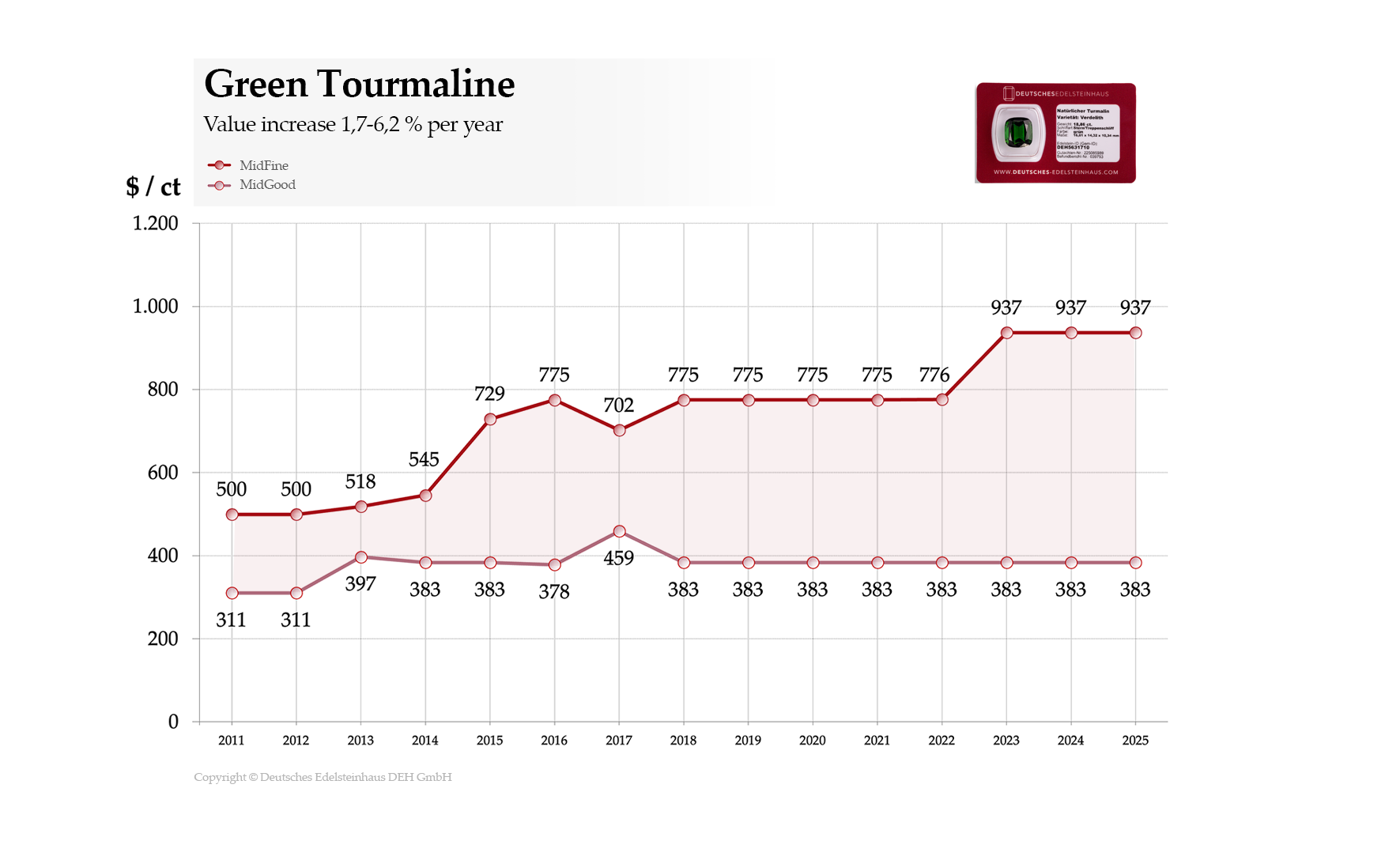
Market position: International demand for untreated tourmalines with clearly documented origin has increased in recent years. High-quality green tourmalines with a homogeneous color profile are available only in limited quantities in the premium segment.
Geological characteristics: Tourmalines have a complex boron-silicate ring structure, enabling an exceptional range of colors. Trace elements such as iron, manganese, lithium, or copper influence the resulting hue.
Green varieties are called verdelite, while particularly rare copper-bearing tourmalines—often referred to as Paraíba-type tourmalines—stand out for their exceptional luminosity.
Tourmalines often exhibit characteristic growth patterns and fluid inclusions that reflect their natural formation. Because of this internal structure, high-quality specimens can be mineralogically complex and are therefore selectively obtainable.

The color effect varies depending on the viewing angle

Investment quality:
very high for top neon colors

Market position:
Long-term stable demand