AQUAMARINE
Essential core:
Quality criteria: Key factors for value retention include a pure, ideally saturated blue tone—especially in the sought-after “Santa Maria” spectrum—high transparency (“eye-clean”), precise cutting proportions, and balanced light return. As carat weight increases, rarity rises disproportionately, particularly when color depth and clarity remain consistent.
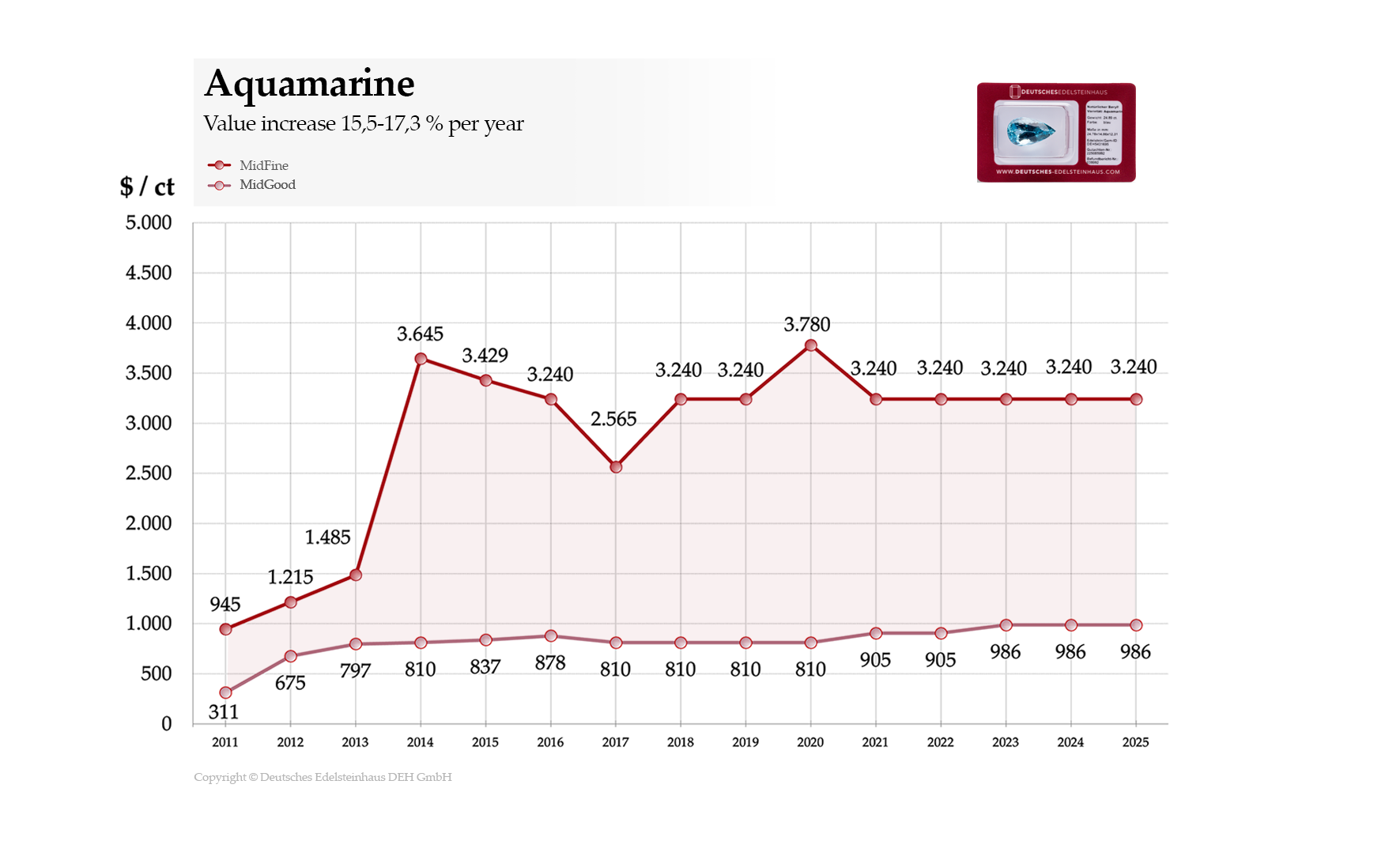
Market position: Aquamarine is internationally recognized and supported by stable demand. Particularly intense blue material has shown sustained appreciation in the high-end segment for years. While overall production volumes are significant, top-quality stones in larger sizes are available only in limited quantities, which supports structural scarcity in the upper quality range.
Characteristics & Origin: Aquamarine forms primarily in granitic pegmatites and hydrothermal veins. Its characteristic blue hue comes from trace amounts of iron in the beryl crystal lattice. Depending on the oxidation state of the iron, color intensity ranges from a delicate sea-blue to a deep ocean blue.
Historically, stones in the so-called Santa Maria color—originally named after a mine in Brazil—have been particularly prized. Other significant deposits are found in Mozambique, Nigeria, Madagascar, and parts of Asia.
Aquamarines are known for high transparency, strong hardness, and long-term durability, and can serve as a tangible, asset-oriented addition to a diversified gemstone portfolio.

Microscopic two-phase inclusions as a geological signature

Investment quality:
high with top color and clear purity

Market position: Stable long-term demand