emerald
Essential core:
Quality criteria: A uniform, rich green with no noticeable brown or yellow tint is crucial. High transparency is desirable, although natural inclusions are acceptable as long as the overall color impression remains dominant. As carat weight increases, rarity premiums rise significantly—especially when clarity is high and cut proportions are well balanced.
Market position: Traditional deposits—particularly in Colombia, Zambia, Brazil, and Ethiopia are showing declining output of high-quality material. New discoveries, including those in Pakistan and Afghanistan, have so far been unable to fully meet premium-segment demand.
Geological characteristics: Emeralds belong to the beryl family and derive their characteristic green color from chromium and, in some cases, additional vanadium. Their formation requires a rare geochemical combination: chromium and/or vanadium sources must meet beryllium-bearing rock in a silica-rich, aluminum-poor environment.
Typical features include natural growth structures and inclusions—the so-called “jardin.” These are not considered defects, but rather mineralogical indicators of natural formation and, in some cases, origin—provided color intensity and transparency are satisfactory.
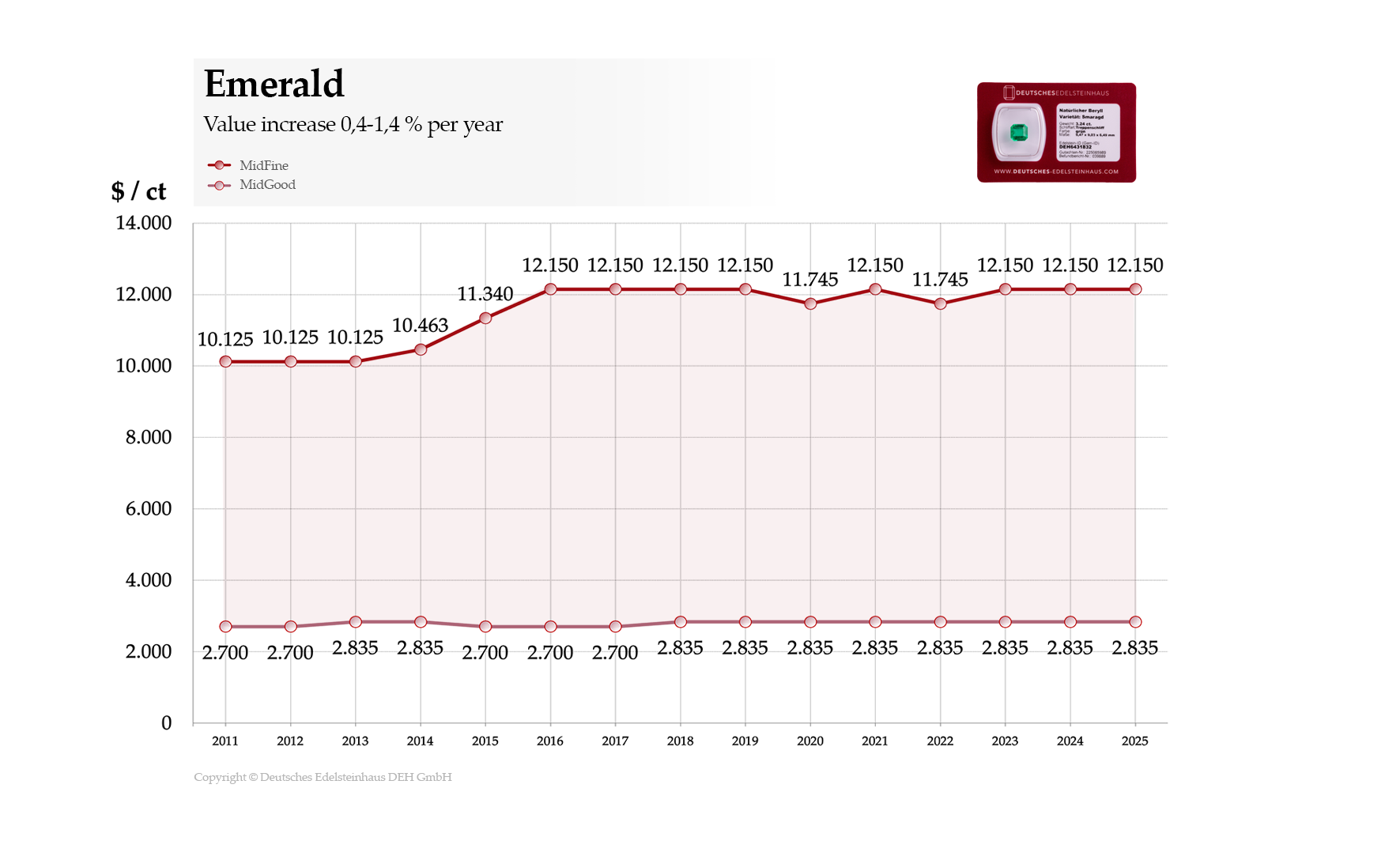
The combination of geological rarity, historical demand, and limited top-end supply positions high-quality emeralds in the upper segment of colored tangible assets over the long term.

Chromium gives the emerald its characteristic green color.

Investment quality:
very high in terms of green credentials and transparency

Market position:
Long-term stable demand