RUBY
Essential core:
Quality criteria: A uniform, vibrant red with strong saturation is crucial, ranging from intense pinkish-red to deep, slightly purplish red. The so-called “pigeon’s blood” color, with its clear and radiant appearance, is particularly sought after.
High transparency and a precise cut that maximizes light return are essential. Natural inclusions are acceptable as long as the overall color impression remains dominant. As carat weight increases—especially from 1, 3, and 5 carats upward—rarity and market value rise disproportionately.
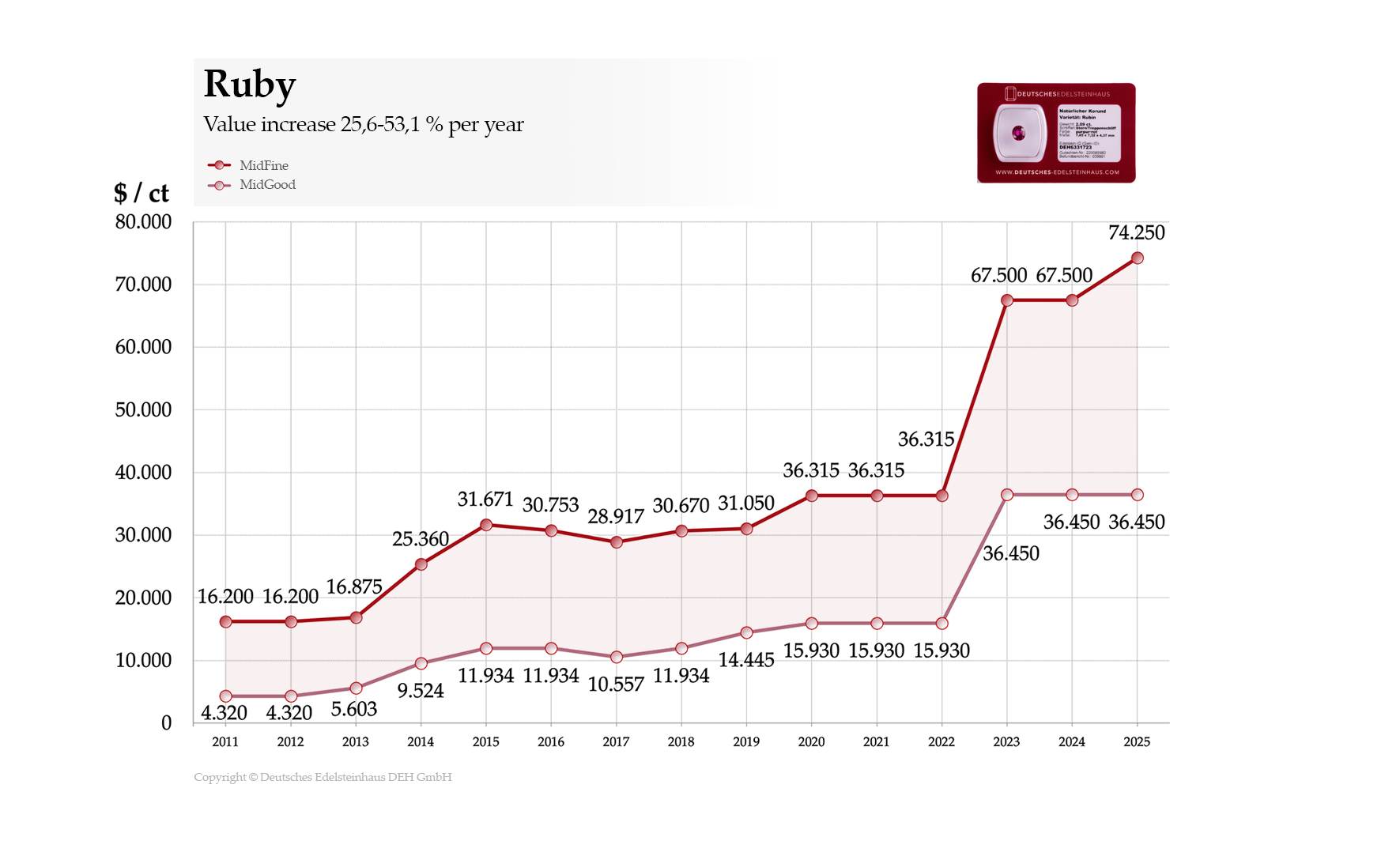
Market position: Rubies are among the most established colored gemstones worldwide and show consistently stable demand. High-quality rubies are available only in limited quantities; fewer major new discoveries in the upper segment contribute to low circulating supply.
Geological characteristics: Rubies form under exceptional geochemical conditions: aluminum-rich rock with minimal silica content and the presence of chromium as the coloring element. This rare combination leads to the formation of red corundum.
Significant deposits are found in Mozambique, Madagascar, Sri Lanka, and parts of Southeast Asia.
Characteristic inclusions—such as rutile needles or typical growth structures—help laboratories assess authenticity, treatment status, and origin. Due to their hardness, color stability, and global market acceptance, rubies are considered a classic core holding in the high-quality colored gemstone segment.

Chromium gives the ruby its red color

Investment quality:
Very high

Market position:
Long-term stable demand